
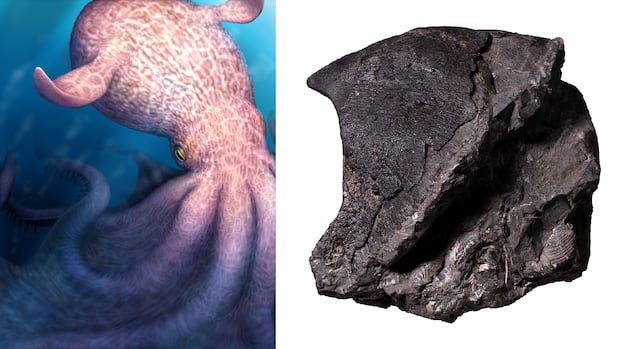

Monstrous octopuses of immense proportions, rivaling modern whales in size, were once inhabitants of the prehistoric seas, as indicated by fossils discovered in British Columbia and Japan. These ancient creatures, resembling mythical sea monsters like the Kraken, reached lengths of up to 19 meters, comparable to the size of a sei whale. The findings, detailed in a recent study published in the journal Science, describe one of the identified species, Nanaimotethis haggarti, as potentially one of the most colossal invertebrates in Earth’s history.
Professor Yasuhiro Iba from the University of Hokkaido, the lead author of the study, highlighted that these ancient octopuses exhibited a remarkable ability to capture and consume heavily protected prey, evident from the wear patterns on their fossilized beaks. Unlike the modern giant or colossal squid, which grows up to approximately 12 meters, Nanaimotethis possessed formidable capabilities for hunting and devouring prey with hard structures like shells and bones.
The presence of these gigantic octopuses alongside formidable marine predators of that era, such as mosasaurs and elasmosaurus, suggests a diverse top predator community in the ancient oceans. The study sheds light on the significance of giant invertebrates like octopuses as apex predators during that period, adding a new dimension to the ecosystem dynamics of the time.
Noteworthy observations from the research include the asymmetrical wear on the octopuses’ jaws, hinting at a preference for seizing prey on one side, indicating a level of intelligence akin to modern octopuses. This discovery underscores the evolutionary mysteries surrounding the ancient octopuses and raises questions about the divergence of their lineage from present-day octopus species.
The fossils of these ancient octopuses, dating back 72 to 100 million years, represent some of the oldest known octopus remains, offering valuable insights into their evolutionary history. The study’s innovative approach of digital fossil mining enabled researchers to reconstruct detailed 3D models of the fossils, confirming the identity of the species and their unique characteristics.
The significance of these findings lies in unraveling the enigmatic evolution of octopuses, a group with limited fossil records, and exploring the transformative changes that have shaped these intelligent cephalopods over millions of years. The discovery of Nanaimotethis challenges our understanding of octopus origins and prompts further investigation into the evolutionary pathways that have led to the diversity of octopus species we see today.