
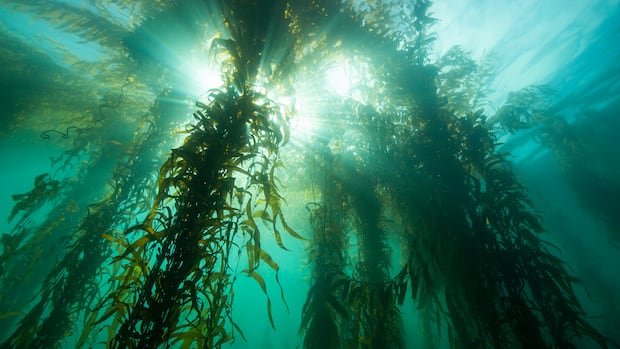

A wealth of lush kelp forests thrives just below the surface near the breakwater along Dallas Road in Victoria. Brian Timmer, a PhD student at the University of Victoria (UVic), noted that these kelp forests are flourishing due to the consistently cold water in the area. However, as one ventures to different parts of British Columbia, they encounter localized pockets of warming known as microclimates.
Once dense with kelp forests, these areas have now vanished, as highlighted in a recent study led by Timmer from UVic and published in Ecological Applications. The research team utilized historical data, including maps, scuba surveys, and aerial photographs dating back to 1972, to examine kelp and its associated macroalgae communities in the northern Salish Sea. In 2023, they replicated these studies to enable direct comparisons.
The study revealed that expansive bull kelp forests once covered over 5.5 million square meters of the northern Salish Sea’s surface, particularly around the Comox and Denman Island region. This amount was ten times greater than the previously established baseline around the year 2000. Unfortunately, none of these kelp forests remain today, with satellite imagery indicating that the majority of the bull kelp loss occurred between 1972 and 1984.
Contrary to popular belief that recent heatwaves were the primary cause of disappearing bull kelp forests in British Columbia, Timmer’s research indicates that the most significant loss occurred several decades earlier. Focusing on a warm water pocket within the Strait of Georgia near Comox and Denman Island, the study identified this region as one of the top 10% globally in terms of ocean warming temperatures.
Over the past five decades, sea surface temperatures at the Chrome Island lighthouse, off Denman Island’s southern tip, have risen by 0.25°C per decade, resulting in a total increase of 1.66°C. It is during these periods of accelerated warming that kelp populations suffer the most damage.
Kelp, considered a foundational species and primary producer, plays a crucial role in sustaining marine life by providing food and habitats for various sea creatures. The decline in kelp forests, as observed by UVic researchers, is attributed to a 78% decrease in sugar kelp and a 98.5% decline in red bladed algae since 1972, likely due to warming waters along the British Columbia coast.
To address this alarming trend, Timmer collaborates with the Kelp Rescue Initiative and First Nations to restore kelp forests in the province. Protection of suitable areas and the reintroduction of kelp species are vital steps towards reversing the decline in kelp populations.