
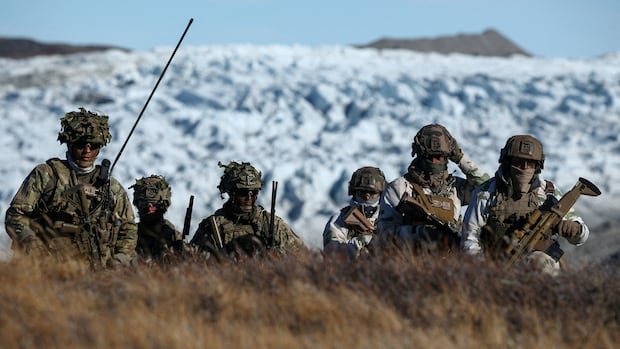

NATO’s Secretary General, Mark Rutte, demonstrated a cautious approach in handling U.S. President Donald Trump’s statements regarding the potential deployment of European troops in Greenland. Recent reports indicated discussions among a group of nations, spearheaded by the U.K. and Germany, about establishing a military presence on the Arctic island as a precaution against American claims.
Trump’s statements hinting at taking action in Greenland, regardless of opposition, and using military force against the semi-autonomous Danish territory, have brought attention to long-overlooked issues by both the NATO alliance and the United States.
Rutte indirectly acknowledged ongoing European deliberations on enhancing Arctic security. However, he played down these talks, stating they are a continuation of earlier discussions initiated by seven allied Arctic nations, including the U.S., back in mid-2021.
“We must collaborate to ensure the safety of the Arctic. Currently, we are exploring the next steps to guarantee practical implementation of these discussions,” Rutte stated. He emphasized the importance of collective efforts within the alliance and by individual allies to uphold Arctic security as a shared priority.
The objective seems to be to convince Trump that NATO shares his interest in strengthening the island’s defenses. This shift is noteworthy considering that Arctic security has been a neglected topic for the U.S. and NATO for many years.
While Canada has increased its focus on Arctic policies and allocated substantial funds for the Far North, the Western military alliance has been caught unprepared for heightened security demands from the U.S. The lack of an official Arctic policy or dedicated regional command within NATO has been highlighted in a recent report by the Arctic Institute Center for Circumpolar Security Studies.
The Pentagon’s recent decision to transfer responsibility for Greenland from the U.S. European Command to the U.S. Northern Command indicates a growing perception of Greenland as integral to U.S. homeland defense strategies.
The report also mentioned that NATO’s reluctance to establish a dedicated Arctic command stemmed from concerns about aggravating Russia, which views the alliance as hostile. However, following Russia’s aggression in Ukraine, NATO has expanded its focus on the region, primarily for European defense purposes.
Trump’s criticism of Denmark’s defense capabilities in Greenland has prompted Copenhagen to increase military spending for the island. Nevertheless, Trump’s rhetoric overlooks the existing U.S. military presence in Greenland and the importance of early warning radars crucial for North America’s defense against potential nuclear threats.
Concerns have been raised about the vulnerability of radar sites in Greenland to hypersonic missile attacks, which could evade detection and interception. Experts suggest the need for an integrated air and missile defense system in Greenland to enhance security and integrate with the NORAD network.
While independence movements in Greenland could complicate Arctic defense strategies, there is uncertainty about future alliances and defense cooperation in the region. The Rand Corporation’s analysis highlights the need for policymakers to consider the implications of Greenland’s potential independence on defense arrangements.
In recent discussions with oil executives, Trump emphasized Greenland’s mineral wealth and accused Denmark of neglecting the territory’s interests, leaving it susceptible to foreign influence. However, Greenland’s efforts to attract Western investment in critical mineral sectors have faced challenges, leading to considerations of partnerships with China.
Greenland’s significant rare earth mineral deposits have attracted Chinese interest, but geopolitical concerns have hindered substantial Chinese investments in the region. Political opposition, especially regarding uranium deposits, has complicated mining developments in Greenland.
The evolving dynamics in Greenland underscore the complex interplay of geopolitical, security, and economic factors that demand careful consideration from stakeholders involved.
[Source](https://www.cbc.ca/news/politics/arctic-nato-us-denmark-greenland-defence-9.7042833)